Create and reuse response templates
Templates are reusable messages. Write them once, insert them anywhere: the chat composer or the broadcast dialog.
Creating a template
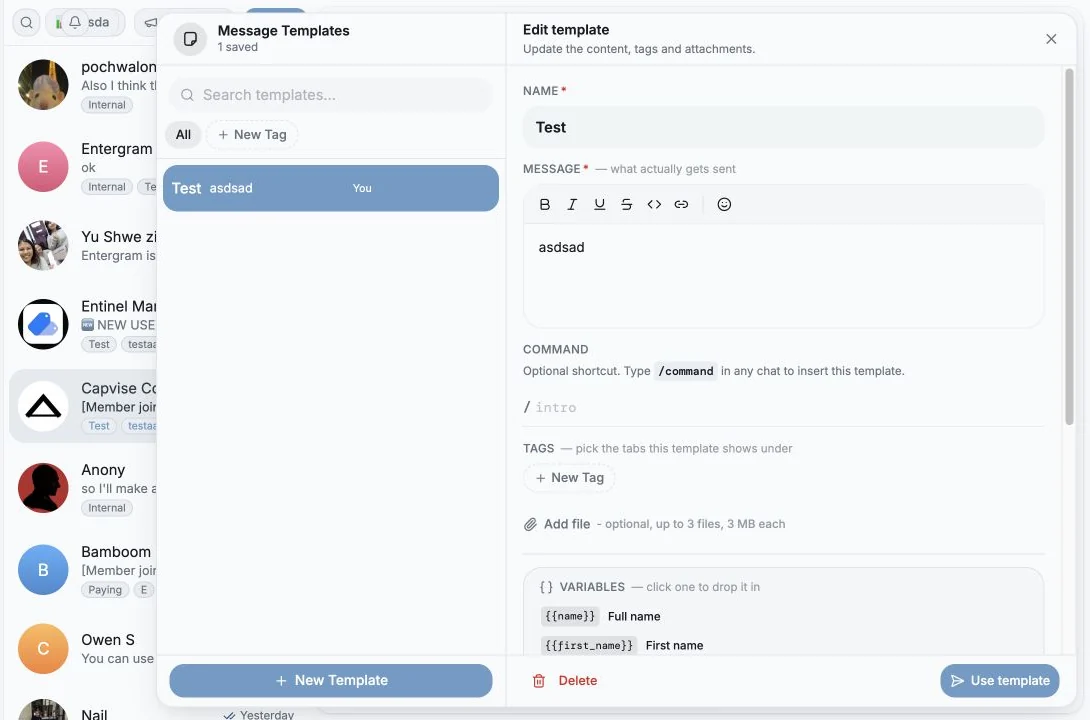
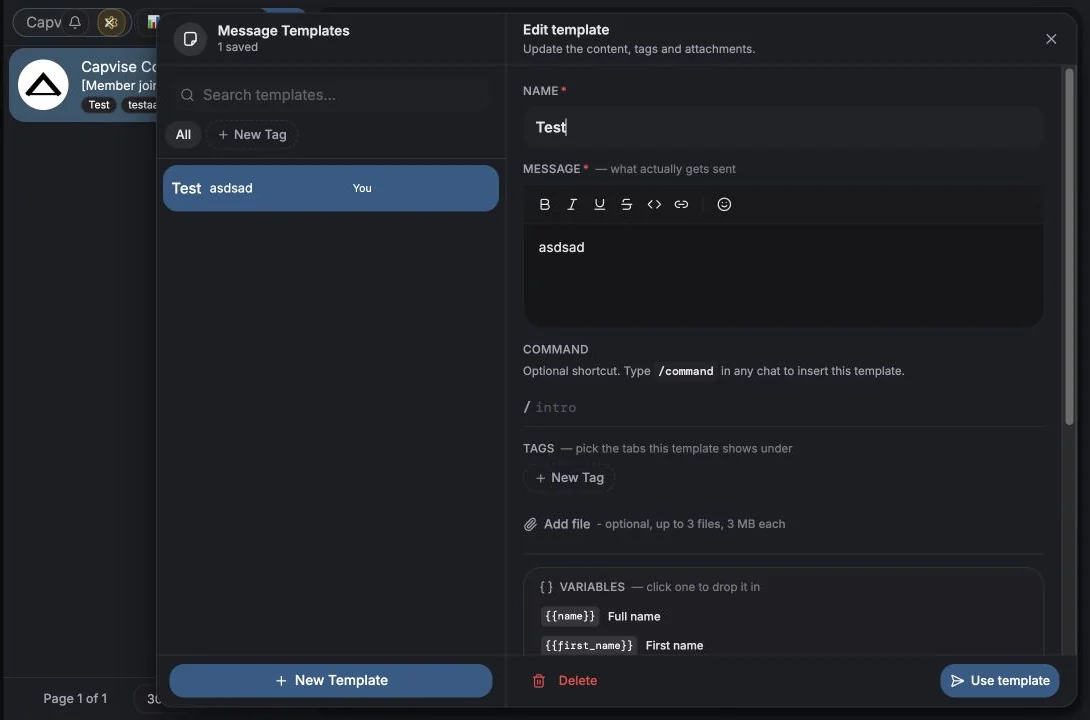
Section titled “Creating a template”Open Templates from the composer or the broadcast dialog, then New Template.
| Field | Notes |
|---|---|
| Name | e.g. Welcome message |
| Content | The message body. Supports the same formatting as the composer and broadcast variables |
| Command | Optional shortcut. Set intro and typing /intro in any chat inserts this template |
| Labels | Free-form tags for filtering. Type a label and press Enter; suggestions appear as you build a library |
| Attachments | Optional files, up to the per-template limit and size shown inline |
Using a template
Section titled “Using a template”- In a chat - open the template picker and click one, or type its
/command. - In a broadcast, Templates in the broadcast dialog.
Variables inside the template are resolved per recipient at send time, so one template greets everyone by their own name.
Finding templates
Section titled “Finding templates”The picker shows “{n} saved” and supports:
- Search by name or content,
- Label filters with All and Clear,
- a Default badge on your pinned default,
- attachment counts (
{n}files) and the variable list per template, - by You / creator name so shared libraries stay attributable.
Personal vs shared templates
Section titled “Personal vs shared templates”Controlled by the workspace setting Share broadcast templates:
| Setting | Effect |
|---|---|
| On | Templates are shared across the workspace. Only the creator can edit or delete a template. Attachment storage pools across seats. |
| Off | Templates are personal to each member. |
Storage usage per template and per member is visible under Settings → Workspace → Data → Template Storage Usage. See Storage & limits.
Managing labels
Section titled “Managing labels”From the picker, a label’s menu offers Rename label and Delete label. Deleting removes that label from all templates and can’t be undone.
Editing and deleting
Section titled “Editing and deleting”Open a template and use Save changes or Delete. Deleting asks
“Delete “{name}”? This can’t be undone.” If templates are shared, only the creator sees the delete action, others see “Only the creator can delete”.
Good template hygiene
Section titled “Good template hygiene”- Keep a default template pinned for your most common opener.
- Use labels by funnel stage (
cold,follow-up,renewal) rather than by person. - Write around missing variables:
{{username}}resolves to nothing for contacts without a handle, so never build a sentence that breaks without it. - Check the broadcast preview with a real recipient before sending a template at scale.
Cookie preferences
We respect your right to privacy. Choose which cookies to allow, your choice applies across our site. Cookie Policy
Required for the site to work, including remembering your privacy choices. Always on.
Help us understand site use and attribute sign-ups to referral partners. Optional.